
The National Initiative for the Blind is a bold and innovative approach to bring literacy, education, skills and services to the four million blind of India, who live on its margins, not just in physical darkness, but in the more crippling darkness of illiteracy and poverty. This Initiative is based on a new, holistic, integrated approach that proceeds from a shared vision of two institutions, a premier educational institution, the IIT Madras, and a committed voluntary service organisation, Vidya Vrikshah, Chennai. It seeks to synergise the power of technology with the power of community self-help in the service of the poor and helpless. It is held up as an example of how the country should evolve its own solutions to solve its own problems.
Holistic and Integrated are key words of the Initiative. The approach seeks to initiate the blind child into the learning process, inevitably, through the sense of touch, which means literacy through the use of braille. This is consciously followed by education through the sense of hearing, provided first by the direct voice of the human teacher, and later by the machine-recorded or generated voice. By bringing the computer into the latter learning process, the door is opened to IT-based skills, which can lead the blind person finally to complete integration as a productive member of the socio-economic mainstream.
The Initiative gives substance to this conceptual approach by simple, natural and inexpensive methodologies. What could be more simple, natural and inexpensive, than that the early training of the sense of touch and the sense of hearing for literacy, is conducted by the mother, that first, universal teacher ? Or that the training be conducted in the mother tongue ? Or that the later process of education and final process of employment be set in the context of use of the local language, in which most of our socio-economic activities are conducted ? The methodologies that we propose rest on these very strengths.
In the teaching of braille, however, we are confronted by a seemingly impregnable barrier. We have been unwittingly locked into a teaching system which assumes and prescribes that braille can be taught only by a teacher trained and qualified to teach braille. Such teachers are small in number and are available only in a small number of blind schools in the country. If we have just one blind school in a whole district, and that can accommodate only a hundred or two hundred children, how are thousands of blind children in each district to be trained. How can a mother living in poverty in a remote village send her blind child to a distant blind school ? No wonder, most of our blind children are condemned to lives of illiteracy, unemployment and poverty. How then are we to bring braille literacy to these children ?
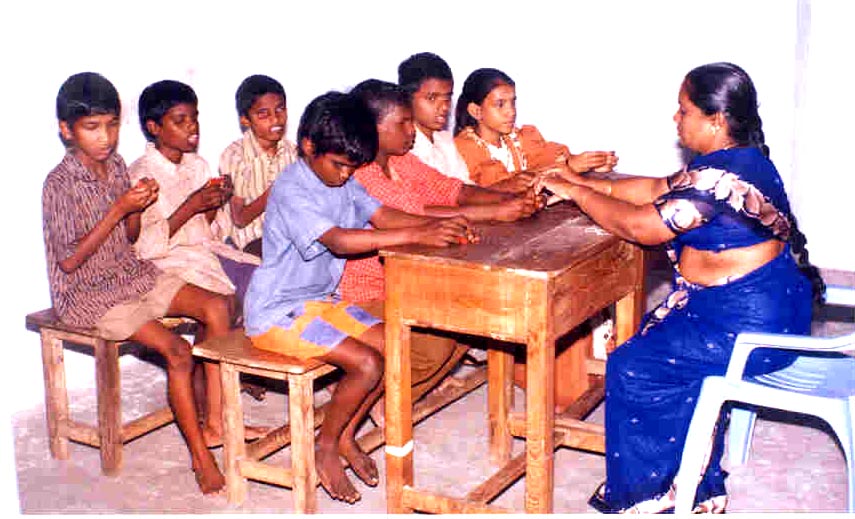
Vidya Vrikshah has a simple answer, constituting the first of the three components of the National Initiative For The Blind. It is, in fact, an astonishingly simple answer, viz. enable the mother to teach the child braille at home; or if she cannot, enable any person who is sighted and literate to do so. To make this possible, Vidya Vrikshah has designed a simple, inexpensive teaching device called the Vasantha Braille Teacher (named after a blind school girl of that name, and daughter of a volunteer of Vidya Vrikshah)
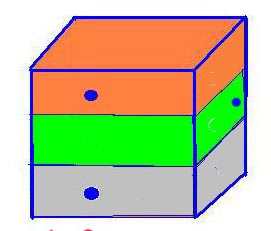
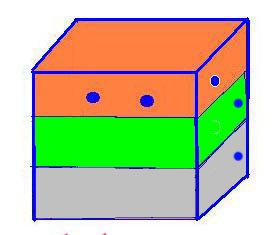
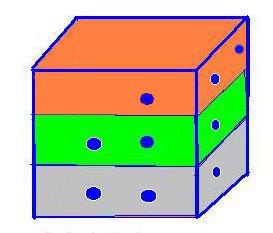
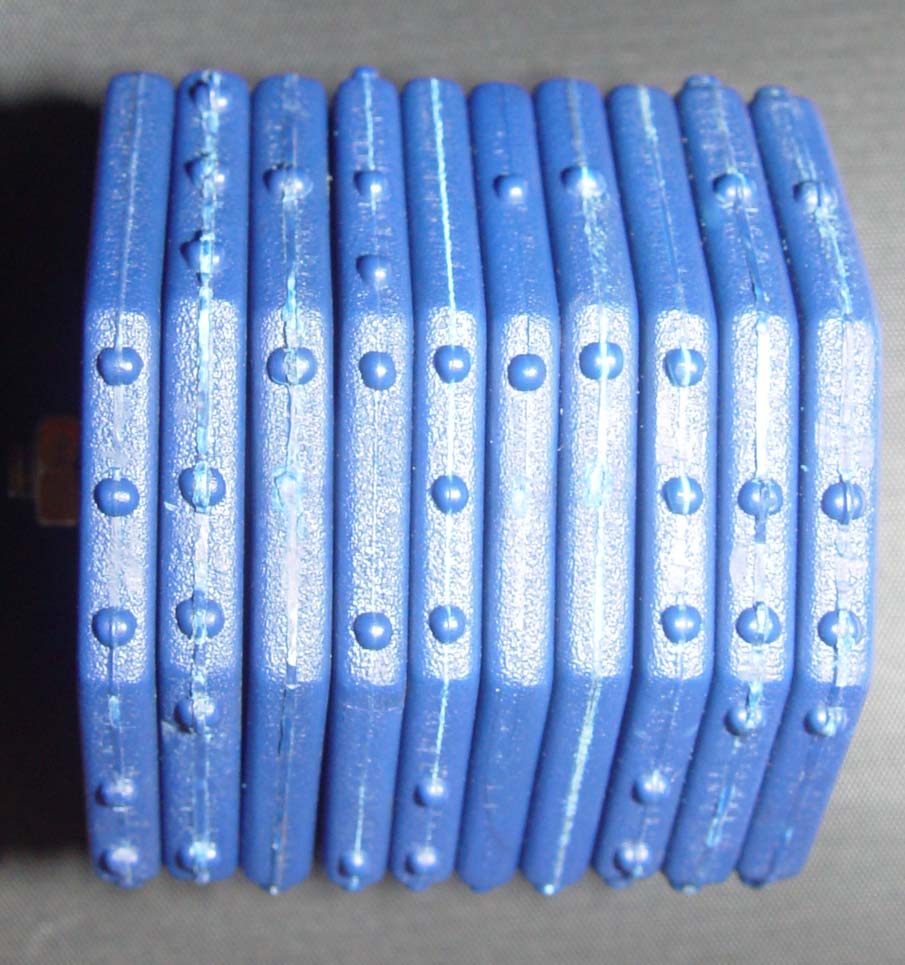
This device is similar to the Rubik’s cube, but has different patterns of raised dots on its sides, corresponding to the Braille representation of letters of any language. The raised dots appear in one or more of six positions arranged in two columns of three rows on each side of the cube. The cube consists of three segments that can be rotated about a common axis, so that different dot patterns corresponding to different letters can be formed on its sides. Each letter of the alphabet of any Indian language (indeed, any world language) can thus be represented on any one side of the cube. The dot positions are numbered 1 to 6 and different patterns of dots on the cube and the letters to which they correspond are as seen in the pictures below :
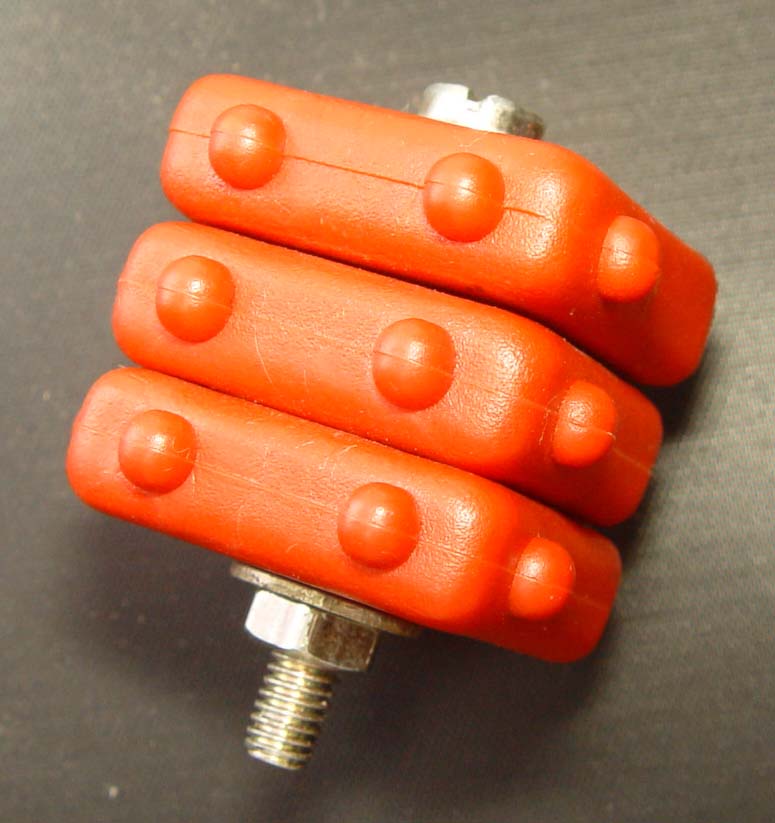
With six dot positions, braille admits of a maximum of 63 possible dot patterns, more than enough for representing all the letters of any alphabet, and all these can be formed on any side of the cube. With a ready reckoner chart containing the letters and their corresponding braille dot patterns, any literate person will be able to learn use of the cube in less than an hour. He or she can then teach a blind person to use it to form all the braille patterns of all the letters on the cube and then memorise them and recognise them by touch. Students of child psychology will readily recognise how the Braille Cube helps to enhance the contribution of the sense of touch to the cognitive process; and also how it brings into early play, the creative processes of associativity and interactivity which are at the heart of the learning process in children. Once the pupil has mastered the braille patterns through the cube, he or she will be able to read real life braille embossed on paper, and master that in less than two months even at the early age of 4 or 5 years. The ideal teacher would be the mother herself, and if she is illiterate, here is a powerful motivation for her to become literate.
The Vasantha Cube was sent to over 200 blind schools in the country for evaluation. Their responses have been enthusiastic and Vidya Vrikshah has been flooded with requests for supply of the cubes in large quantities, for use, not only by blind children in these schools, but also by blind children in neighbouring villages, through out-reach programmes. Under this first component of thr National Initiative,, bulk production of the Cube has been taken up for being sent free of cost to reach all blind children in the country through the Blind Schools and through volunteers. Volunteers are also being mobilised to distribute the cubes and train mothers or other literate inmates, welfare workers and teachers on how to use the cube to teach blind children in homes, local welfare centres and local schools in the villages.
Cubes have already
been sent as follows :
Indore (MP) :
150 ; Devas (MP) : 50 ; Hyderabad (AP) : 500; Orissa : 250
Bhavnagar (Gujarat) : 250 Cuddalore : 50 Tiruchirapalli : 50; Coimbatore
: 50; Nagercoil : 50 ; Madurai : 300; and
Miscellaneous receipients : 200
Braille-based
education, of course, does not go far enough, as it cannot
sustain the wider real-life needs of higher education and employment. This
is where the second component of the National Initiative for the Blind,
provides a complete answer, viz. Computer-based Education and Training.
This is accomplished through a remarkable software package developed by
the IIT Madras, which has the following features :
(a) It enables
easy use of computers in all Indian languages and also English. by all,
including the physically disadvantaged.
(b) It provides
for voice and braille computer output in all these languages, with voice
support for screen navigation and editing, to serve the special needs of
the blind.
The software
is provided free of cost, through free downloads from the IIT’s website,
(http://acharya.iitm.ac.in/) and also through Vidya Vrikshah, which in
addition, provides free training.
To illustrate
the ease and versatility of the software, entry of the same letters
KmlA
on the common English keyboard of a personal computer would, depending
on the language option chosen, display the same word, viz. Kamala, in Hindi,
Tamil, Telugu, Kannada, Malayalam, Oriya, Bengali, Gujarati, Punjabi, Grantha
(an archaic script), IPA (diacritised English), Braille, Sinhala and Urdu
respectively as shown below. (Support is available for Arabic, Persian
and Hebrew as well). It will be noticed that the typing proceeds on a simple
phonetic basis that is uniform for all languages.
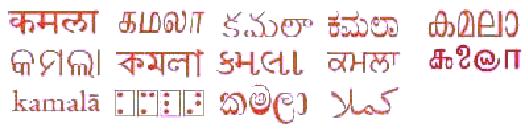
It may be incidentally noted that that the Braille representation for all corresponding letters is near identical across all these scripts, thanks to the very fine uniform national standard established for them, called Bharathi Braille.
Taking a more specific realistic example in a specific language, suppose one chooses Tamil and types in the following letters :


Nearly 250 persons from all over the country, a large number of them blind, or teachers of the blind, have been given this software with training, free of cost, by Vidya Vrikshah. The far-reaching value of this software for the blind was recently recognised by the Government of India by the National Award for the Best Technology Contribution for the Disabled for the Year 2003.
While the two components of the National Initiative described above, address the literacy and education needs of children, a third component addresses the special needs of the wider blind community, in terms of braille, training and other services. Under this component, it is proposed to enlarge the role of the blind schools which is at present limited to education of blind children. The idea is to re-orient these institutions to function as Special Resource Centres to provide the following services to all the blind in the districts in which they are located :
(a) Produce and
distribute the Braille Magazines and School Text books for children as
described earlier, free of cost, by equipping them with special Braille
Printers.
(b) Provide braille
output services to all other blind persons in the district at a nominal
cost.
(c) Offer training
courses for mobility, travel, and other activities of coping with the environment.
(d) Offer computer-based
vocational training courses like data entry, job typing, email and browsing
services, running public call offices etc.
The National Initiative for The Blind was formally launched at a public function on the 27th December, 2003 at Chennai. There was live presentation of all the three component methodologies at this function in the presence of His Excellency, the Governor of Tamil Nadu, who described them as “remarkable and revolutionary”. The Initiative for Tamil Nadu, was inaugurated by Dr.M.Anandakrishnan, one of the most distinguished and far-seeing educationists of the country, who is currently Chairman of the prestigious Madras Institute of Development Studies. Dr Anandakrishnan made a powerful plea for a national coalition of Educational authorities and Institutions and Voluntary Services, for massive implementation of the Initiative. Specifically he suggested mobilising students who formed a vast reservoir for voluntary services, and whose high idealism and motivation could greatly add to the impact of the implementation process.
Implementation of the Initiative has been started with the distribution of the Braille Cubes, Computers, and all the related software, along with training, all free of cost, to all Blind Schools in Tamil Nadu. As of 31-01-2004, the first five Blind Schools have already been covered, and the rest are to be covered by the end of 2004. Steps are under way to form Chapters of the Initiative in Andhra, Kerala and Karnataka.
The value of the methodologies of the National Initiative is not limited to the blind alone. As rightly highlighted by Dr.Anandakrishnan in his inaugural address, Its IT solutions have equal relevance to the needs of the sighted as well. The basic software tools from the IIT Madras have in fact been used by Vidya Vrikshah to develop a whole suite of applications in all languages in the fields of literacy and education for the sighted, training in Health Awareness, Self-Help and Empowerment for women, and special training for persons with other disabilities. Presentations of these can also be viewed in their website at www.vidyavrikshah.org, which demonstrate how effectively inter-active distance education and training of high quality, in local languages, can be provided on the Internet. In another of its related initiatives, called the Vikas Initiative, Vidya Vrikshah provides computers with all these application packages and with training in their use, structured as Vikas Training Centres, free of cost to schools and women’s welfare centres in the rural areas. As of 31-12-2003, 25 such Centres have been established.
Between the National Initiative For The Blind and the Vikas Initiative, we surely have a national model for a broad infrastructural base of literacy and education for all, able or disabled, which will bring to all of them, the benefits of all-round socio-economic progress. And if volunteers, especially students, come forward in large numbers to implement these two initiatives, who could be better soldiers to successfully spearhead this socio-economic revolution ?
All these
activities have proceeded from material support and contribution of voluntary
services from the community. Yet surely, there is place and need for a
broad synergy, a broad coalition proposed by Dr.Anandakrishnan, of
governmental and non-governmental effort based upon such approaches.
These software solutions go well beyond the needs of literacy and education.
They are far-reaching in that they can accomplish wider national objectives
like uniform standards of e-governance in the country and uniform
standards of electronic communication across the languages of the country.
These surely, are at the heart of the basic processes that can make
President Kalam’s Vision-2020 a national reality. Indeed, proven
solutions that can usher in this reality are available today in our hands.